How to Choose the Best Laser Film for Global Sourcing?
Choosing the best Laser Film for global sourcing requires more than comparing prices or surface effects. A bright holographic pattern may look impressive under showroom lighting, yet fail during lamination, printing, or transport. Buyers must examine optical clarity, film thickness, adhesive compatibility, roll width, and surface durability. Small differences can affect waste, production speed, and final appearance.
Reliable sourcing begins with a clear application brief. Is the film intended for packaging, labels, decorative panels, or brand protection? Each use demands different performance. Request technical data sheets, recent test reports, and physical samples from several suppliers. Check the sample under direct light, angled light, and ordinary warehouse conditions. Ask how the film performs after cutting, folding, heat exposure, and long-distance shipping. These details often reveal more than a polished product photograph.
Supplier evaluation matters equally. Review manufacturing experience, quality-control procedures, export history, and communication speed. Confirm whether the supplier can maintain consistent color, pattern alignment, and thickness across repeated orders. Independent inspections can reduce avoidable surprises, although they cannot replace your own testing. No sourcing plan removes every uncertainty. A sample may pass while a larger batch varies slightly. That possibility deserves attention. Buyers should also verify packaging standards, documentation, and destination-market requirements before signing a purchase agreement. The best choice is not always the cheapest Laser Film. It is the option that balances visual impact, technical reliability, compliance, and predictable supply.
What Is Laser Film and How Is It Used?
Laser film is a thin polymer sheet engineered for laser exposure, marking, cutting, or image transfer. It is not ordinary plastic. A film may contain a heat-sensitive coating, a colored surface layer, or a light-reactive emulsion. Under controlled laser energy, selected areas darken, vaporize, or separate from the base material. This creates labels, control-panel graphics, identification plates, packaging details, and screen-printing positives.
Its performance depends on more than appearance. Film thickness, surface energy, laser wavelength, coating adhesion, and heat resistance all affect the final result. A 100-micrometer sheet may handle fine text well, while a thicker sheet can provide better dimensional stability. In practical sourcing, a sample can look perfect but fail after repeated wiping or heat exposure. Test it early. Measure edge sharpness, contrast, curl, and residue after production. That step is often missed.
Demand is expanding with industrial traceability. Grand View Research estimated the global laser marking machine market at approximately USD 3.1 billion in 2023, with continued growth expected through 2030. This growth supports wider use of compatible films in manufacturing and packaging workflows. The Smithers report, The Future of Packaging to 2028, also identifies connected, variable, and digitally controlled packaging as major development areas. However, report figures vary by market definition. A buyer should request technical data, wavelength compatibility, batch consistency, and documented test results before global purchasing. One weakness remains: supplier descriptions may use “laser film” broadly, even when the material is intended only for printing or engraving.
How to Choose the Best Laser Film for Global Sourcing?
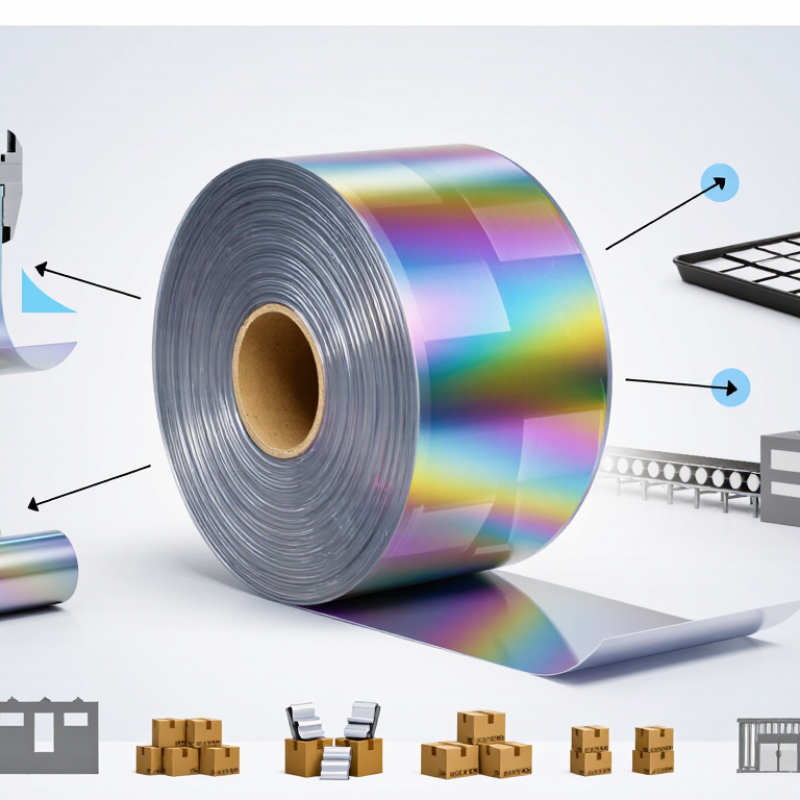
Laser film is a plastic film, commonly PET, with a holographic or diffraction-based surface that creates changing colors and light effects. It is used for flexible packaging, labels, decorative lamination, security documents, gift wrapping, and promotional materials.
The chart shows commonly specified PET film thicknesses used as carriers or substrates for laser-embossed and holographic films. Thinner films support lightweight packaging and labels, while thicker films generally provide greater stiffness and dimensional stability for lamination, displays, and durable decorative applications. Final selection should also consider optical effect, coating compatibility, heat resistance, roll width, and converting equipment.
Which Laser Film Specifications Matter for Global Sourcing?
How to Choose the Best Laser Film for Global Sourcing?
Which Laser Film Specifications Matter for Global Sourcing?
Laser film selection starts with measurable specifications, not attractive samples. Film thickness, typically 12–50 microns, affects stiffness, yield, and shipping weight. Small errors multiply. A 2-micron variation can change converting performance across long production runs. Smithers’ 2024 global packaging report forecasts flexible packaging demand approaching US$300 billion by 2028. That scale makes material consistency commercially important. Ask suppliers for thickness tolerance, roll width, core size, and maximum roll weight.
Optical performance needs equal attention. Request haze, gloss, diffraction uniformity, and color stability data. A bright sample may hide uneven coating under warehouse lighting. Mordor Intelligence’s 2024 holographic film analysis projects market growth above 6% annually through 2029. Buyers should connect that growth with testable quality controls. Use ASTM or ISO-based testing for adhesion, abrasion, heat aging, and humidity resistance. Do not accept “excellent durability” without test conditions.
Adhesive compatibility matters.
Check coating and lamination temperatures before approving production. Confirm peel strength after 24 hours and after climate exposure. Packaging teams should also review restricted-substance declarations, recyclability claims, and regional documentation. A wider roll is not automatically better. It may increase trim waste and handling damage. I would request pilot rolls from at least two production lots, then compare yield, optical uniformity, and defect rates. That step costs time, but skipping it can cost far more.
How to Compare Laser Film Materials, Finishes, and Performance
When choosing laser film for global sourcing, compare the material before judging its appearance. Polyester film usually offers stable dimensions, clear optics, and reliable heat resistance. PVC can be more flexible and economical, but its performance may change under heat or prolonged storage. Polycarbonate provides toughness for demanding applications, although it can cost more and require tighter processing control. I have seen attractive samples fail after humidity testing. The material choice was not the problem alone; the adhesive and storage conditions also mattered.
Finish changes both visual impact and production risk. A bright mirror finish can create strong reflections under focused light, while a satin finish hides minor handling marks. Holographic effects may improve shelf visibility, but they can reduce readability when viewed from certain angles. Check coating uniformity across the full roll, not only on a small sample. Ask for measurable data, including haze, gloss, thickness tolerance, adhesion, abrasion resistance, and recommended temperature ranges. Request samples from different production lots. One sample is not enough.
Performance testing should reflect the final application. Test printed film after cutting, forming, exposure to moisture, and repeated handling. Confirm whether colors shift under warm or cool lighting. Supplier documentation should include safety data, quality controls, inspection methods, and applicable market requirements. In my experience, technical sheets can sound complete while omitting roll-edge defects or curing limits. That gap deserves direct questions. A simple pilot order often reveals more than a polished presentation. Test realistically. Suppliers should explain failures, not only display successes.
How to Evaluate Suppliers, Certifications, and Production Quality
How to Choose the Best Laser Film for Global Sourcing?
Flexible packaging is becoming more demanding. Smithers’ 2024 market study projects the global flexible packaging market will reach about $300 billion by 2028. This growth increases pressure on laser film suppliers. A reliable supplier should provide consistent holographic clarity, controlled thickness, stable adhesion, and documented raw-material traceability. Ask for recent certificates, not scanned files from years ago. ISO 9001 supports quality management, but it does not guarantee perfect film on every production day.
Certification is only one checkpoint. The ISO Survey 2023 recorded more than 1.26 million ISO 9001 certificates worldwide. That number shows broad adoption, not automatic production excellence. Request test reports for haze, gloss, tensile strength, coating adhesion, and dimensional stability. Check whether an independent laboratory performed the tests. Review calibration records and batch-level certificates of analysis. Small details matter. Can the supplier trace one finished roll to its resin lot, coating line, operator, and inspection record?
During sampling, inspect the film under angled light. Look for pinholes, uneven rainbow effects, curl, and weak lamination. Ask for production samples from different dates, not only a carefully selected roll. I have learned that impressive samples can hide unstable output. Supplier audits should include slitting, packing, humidity control, and complaint handling. A practical trial may expose problems earlier than a polished presentation. Still, even a good trial is not proof of long-term consistency. Require agreed tolerances, retention samples, and corrective-action timelines before global sourcing.